Many people assume staying consistent with habits is a willpower problem.
But often the real issue is something else entirely: environment and accountability.
And sometimes what we call “peer pressure” is actually one of the most powerful forces helping people follow through.
Not all pressure is bad.
There is a lot of messaging right now about saying no.
Protecting your energy. Setting boundaries. Not overextending yourself. Not people pleasing.
And for many people, that message is important. A lot of us do need to stop automatically saying yes to everything.
But here is the nuance I keep coming back to: sometimes the goal is not to remove pressure altogether. Sometimes the real work is learning to recognize the difference between pressure that pulls you away from yourself and pressure that pulls you toward the person you want to become.
For high-performing people especially, the answer is not always more discipline or more willpower.
Sometimes it is simply placing yourself in environments where participation, effort, and follow-through are already happening.
In other words, accountability.
Why “peer pressure” might not be the problem
Peer pressure is not exactly a trendy wellness topic.
It usually gets framed as something negative. Something immature, unhealthy, or misaligned. Something to resist.
But that framing is incomplete.
Because sometimes being around other people who are showing up, participating, and following through changes your own behavior in powerful ways.
Not through shame.
Not through performance.
Not through force.
But through proximity.
Through being in a room that reminds you what you value.
Through seeing other people do hard things and feeling yourself rise a little too.
What changed for me
Last year, I made a quiet commitment to reconnect with things that fill my cup.
Not just work.
Not just motherhood and family.
Not just productivity.
Actual joy.
For me, one version of that looked like joining a choir.
Which sounds lovely and wholesome. And in many ways, it is. But the actual experience was me walking into a room where a panel was sitting behind a table, and suddenly it felt a little more scary American Idol audition than charming choir moment.
And even though I’ve auditioned plenty of times in my life, that very human fear response was still there.
What if I’m not good enough? What if I can’t do it?
It would have been easier to cancel.
To stay home.
To come up with an excuse.
But I did it anyway.
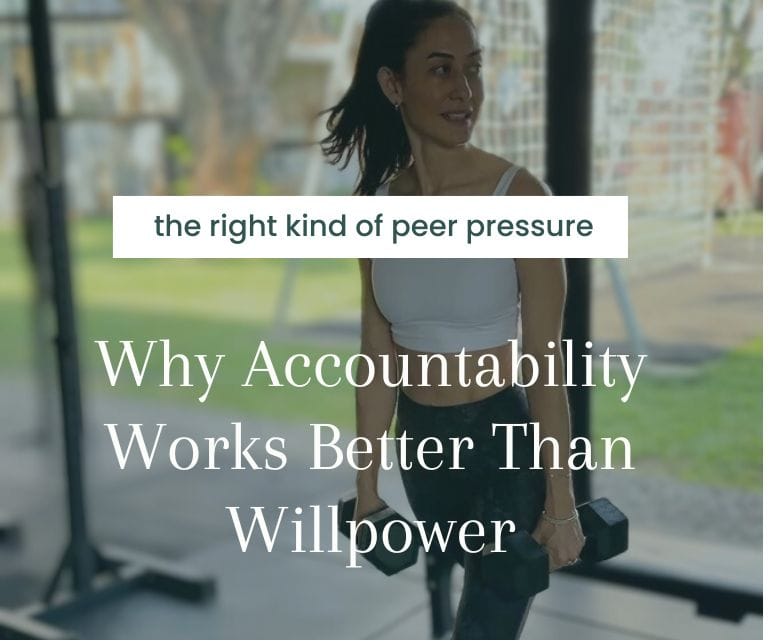
Around the same time, I also joined a gym in my neighborhood.
Did I need to?
Objectively, no.
I have programs. I have equipment. I know how to train. I have taught hundreds of classes. I can write my own workouts in my sleep at this point.
But something shifted when I started training around other people again.
Even while we were all doing different things.
I noticed I worked harder.
I stopped negotiating with myself.
I stayed focused.
I caught myself pushing through the last brutally hard set because the younger man and older woman beside me were still going.
That matters.
We are wired to respond to the presence of other people.
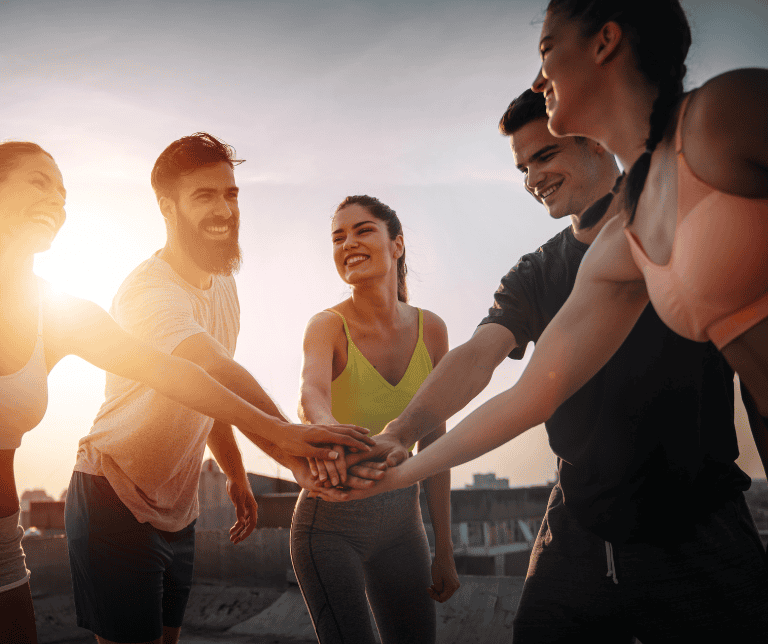
The Science of Social Facilitation
There is real science behind this.
Humans tend to regulate effort differently in the presence of others. This is known as the social facilitation effect.
In simple terms, we are often more likely to perform, persist, or increase our effort when other people are around.
Research has found that the presence of others can influence performance and effort, and that social support and group environments can improve motivation and follow-through over time.
This does not mean you need to turn everything into a team activity or become someone who thrives on group settings.
But it does mean something important.
You may not need more willpower.
You may need the right environment.
Why High Performers Often Struggle With Consistency
This is the part I think high-performing adults often miss.
When life gets heavy, many capable people isolate.
They tell themselves they should be able to handle it alone. They retreat, tighten up, and assume they will get back on track next week. They over-rely on self-control and underuse support.
But isolation quietly erodes follow-through.
The right room can raise it.
The right conversation can raise it.
The right kind of pressure can raise it.
Not because someone is forcing you.
Because something in you wakes up when you are around people who are participating.
This was the thought that stayed with me after a recent accountability call with a small group of women I respect deeply.
We originally came together around business and personal growth, but the conversations always end up being about more than that.
One of the things I have not been doing enough of lately is reaching out. Sharing more. Letting my thoughts be seen before they are perfectly formed.
And on that call, the women in that group gently pushed me on that.
So this post is me saying YES to that pressure.
Because it brings up this thought that I keep circling:
You do not always need less pressure. Sometimes you need better pressure.
Pressure that reflects your values.
Pressure that reminds you who you said you wanted to be.
Pressure that nudges you toward participation instead of isolation.
What “Better Pressure” Actually Looks Like
Better pressure is not about becoming more externally driven or dependent on approval.
It is not about doing things for appearances.
It is not about pushing yourself past capacity just because other people are watching.
Better pressure might look like:
- joining the class you keep saying you will try
- training in a space where other people are showing up
- saying yes to a group that stretches you in a good way
- letting yourself be accountable before everything feels polished
- putting yourself in rooms that support the version of you you are becoming
Sometimes boundaries are the work. Sometimes participation is the work.
Wisdom is knowing which season you are in.
A Better Question to Ask Yourself
Instead of only asking:
What do I need to say “No” to right now?
It may also be worth asking:
Where might saying yes to the right kind of pressure actually support me?
Is there a room you have been avoiding?
A group you would genuinely enjoy?
A commitment that feels uncomfortable but aligned?
Not pressure that pulls you away from yourself.
Pressure that pulls you toward who you are becoming.
One final thought
We are not built to do everything alone.
And despite how polished, capable, or self-directed you may be, you are still influenced by the environments you put yourself in.
That is not weakness. That is being human.
The goal is not to eliminate pressure from your life.
The goal is to choose pressure that makes you more honest, more supported, and more likely to follow through on what matters.
P.S. If you’d like some professional peer pressure to help you stay on track, I’d love to help.
References
Bond, C. F., & Titus, L. J. (1983). Social facilitation: A meta-analysis of 241 studies. Psychological Bulletin, 94(2), 265–292. https://doi.org/10.1037/0033-2909.94.2.265
Carron, A. V., Hausenblas, H. A., & Mack, D. (1996). Social influence and exercise: A meta-analysis. Journal of Sport & Exercise Psychology, 18(1), 1–16. https://doi.org/10.1123/jsep.18.1.1
Edwards, A. M., Dutton-Challis, L., Cottrell, D., Guy, J. H., & Hettinga, F. J. (2018). Impact of active and passive social facilitation on self-paced endurance and sprint exercise: Encouragement augments performance and motivation to exercise. Frontiers in Psychology, 9, 710. https://doi.org/10.3389/fpsyg.2018.00710
Yorks, D. M., Frothingham, C. A., & Schuenke, M. D. (2017). Effects of group fitness classes on stress and quality of life of medical students. The Journal of the American Osteopathic Association, 117(11), e17–e25. https://doi.org/10.7556/jaoa.2017.140